Light costs gas
The lamp shows what a passenger really is, but it burns a 16-second gas budget. Below 30% the slips come back UNREADABLE and the booth goes dark.
Junior software engineer · Ankara · 2026
I build games in my own time, end to end: design, code, art pipeline and testing. One is a slow, lamp-lit horror game for PC. The other is a fast arcade climber for phones. Every image on this page comes from these two projects.
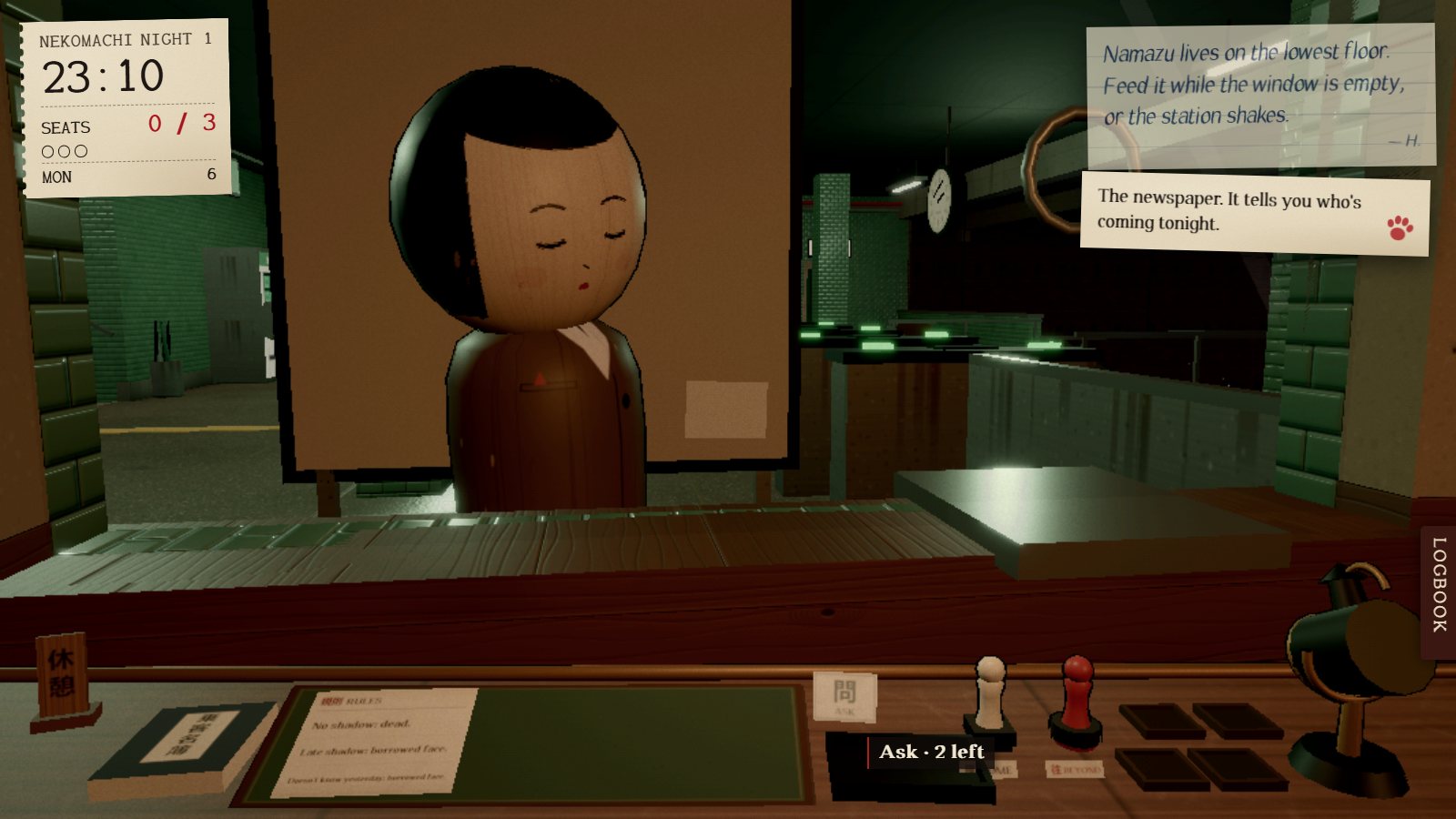
1998, the small town of Nekomachi. You work the only ticket window of a station that closes in twelve nights. The living and the dead wait in the same queue. At 02:10 two trains arrive: Platform 1 takes the living home, Platform 2 takes the dead beyond. Some of the dead are wearing living faces. You have a lamp, a few questions, a logbook and the evening paper.
The lamp shows what a passenger really is, but it burns a 16-second gas budget. Below 30% the slips come back UNREADABLE and the booth goes dark.
Cross-check answers against the newspaper and the logbook. A certain slip never lies. Disguises only blind you, so a fake always leaves at least two contradictions.
Stamp each passenger 帰 HOME or 往 BEYOND. Nobody runs away: they wait on their platform, and by 02:10 the platforms read like a ledger of your night.
From concept to the booth
The first concept was a cross-section model of a Japanese station, rendered in Blender from Python scripts. A grey-box prototype proved the management idea was not fun, so I kept the world and the wooden kokeshi passengers and rebuilt the game around one decision: who is alive.
The art moved with it: from glossy lacquer to worn wood, hard lamp light and sick green fluorescents. Heads are sculpted by script in Blender with a living and a dead variant; bodies are lathed in code.
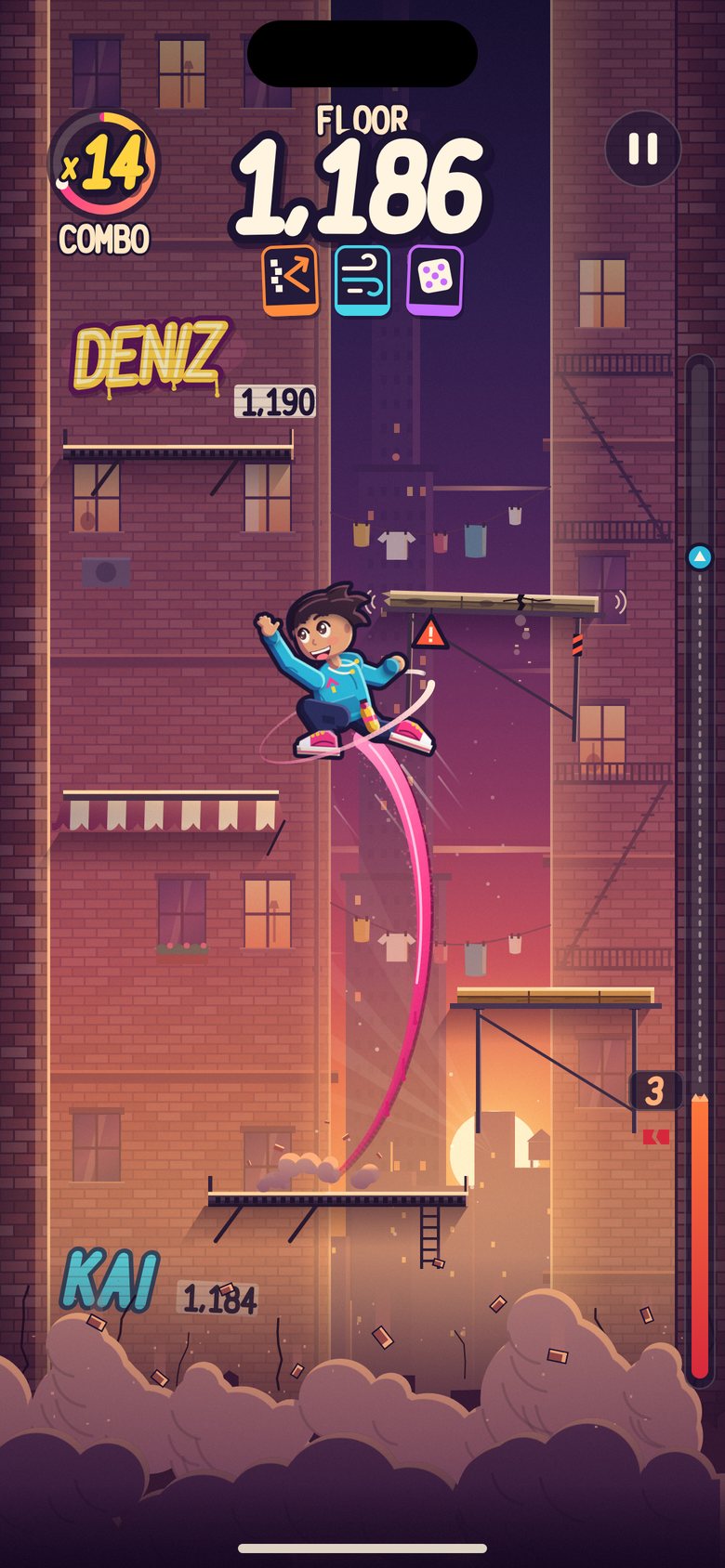
A vertical arcade climber made for one thumb. You run along the floors of a city block, turn speed into height, bounce off walls into combos and keep ahead of a camera that never stops rising. Each city has its own look, music and platform types, and every run can be replayed frame for frame.
The faster you run, the higher you go. A long run-up can clear several floors at once.
Chain multi-floor jumps and wall bounces to build a combo multiplier and climb faster.
From the 10th floor the camera climbs on its own and speeds up. Fall below it and the run is over.
Hold for higher, bigger jumps and slide sideways to steer. The scheme came from watching how people actually held the phone.
The engine under it
The game logic runs in its own simulation: a fixed 50 Hz step, fixed-point maths and a seeded random generator. Rendering only reads from it. Because the simulation is deterministic, a run is just its inputs, which gives you exact replays and ghost races for free, and is the base for live 1v1 racing with rollback.
Automated tests replay recorded runs and check that the result never changes, and they check that old save files still load after every schema change.
// every 20 ms, independent of frame rate
tick(state, input)  // fixed-point, seeded RNG
  move(player, input)
  collide(player, platforms)
  combo.update()
  camera.rise(state.floor)
// render: interpolate between two ticks
draw(lerp(prev, cur, alpha))
// a run = seed + inputs → replay, ghost, 1v1
5 cities are in the game with 26 platform types and Endless, Daily and Weekly modes. More were explored as concept frames before production.
How I build
I write and steer the code with Claude Code. For each game I set up a team of specialised AI agents, 15 for SHŪDEN and 17 for UPTAG, covering game design, art direction, UX, sound, performance and QA. They draft, review and argue. I decide what goes in, read the changes, and play every build myself on real devices.
| In my games | In Unity |
|---|---|
| Fixed 50 Hz simulation tick | FixedUpdate |
| Platform and city definitions as data | ScriptableObjects |
| Small objects composed of systems | Components |
| Blender to GLB export pipeline | Asset import |
| Java OOP from university | C# classes |
I'm a 2025 graduate based in Ankara and open to relocation. Happy to walk through either game, live.